From Docking to Bench: An Experimental Validation Pipeline for Top Docking Hits from Medicinal Plants
DOI:
https://doi.org/10.64474/3107-6688.Vol1.Issue3.1Keywords:
- Molecular Docking, Medicinal Plants, Curcumin, Withaferin A, Gymnemic Acid, Antioxidant Activity, Anti-Inflammatory Activity
Abstract
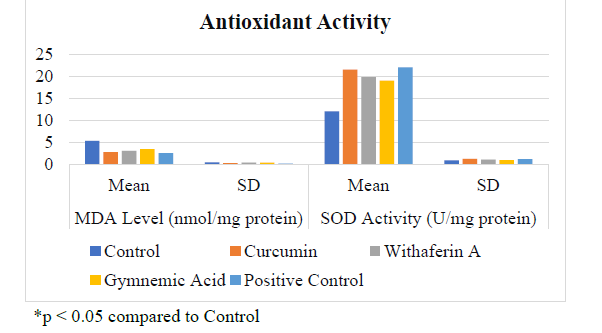
Computational biology methods, including virtual docking, which are a prediction of the interaction between phytochemicals and disease-relevant target proteins, can be used to speed up the discovery of bioactive compounds in medicinal plants. In silico predictions however need experimental validation to determine biological efficacy. This study provides a systematic pipeline, which combines molecular docking and in vivo validation to determine the interesting antioxidant and anti-inflammatory compounds. Phytochemicals of Curcuma longa, Withania somnifera, and Gymnema sylvestre were docked against oxidative stress-related and inflammatory target proteins, and the docking hits upon which the phytotoxins Curcumin, Withaferin A, and Gymnemic Acid ranked highest were investigated using Wistar rats. Findings indicated that oxidative stress markers (MDA) and pro-inflammatory cytokine (TNF- 6, IL- 6) were significantly reduced, and antioxidant enzyme activity (SOD) was elevated, as predicted by the affinities of docking. The results show that there is a high correlation between the computational predictions and experimental results, which confirms that the pipeline is a secure method to use plant-derived compounds to predict what they can be used in preclinical drug development. This combined approach provides a generalizable platform on which to connect in silico screening and in vivo validation to enable the identification of plant-based therapies to address oxidative stress and inflammation.