AI-Enabled Nanopharmaceutical Design: Predictive Modelling for Next-Generation Therapeutic
DOI:
https://doi.org/10.64474/3107-6688.Vol2.Issue1.4Keywords:
- Nano Pharmaceuticals, AI, Biological, Nanomedicine, Safety.
Abstract
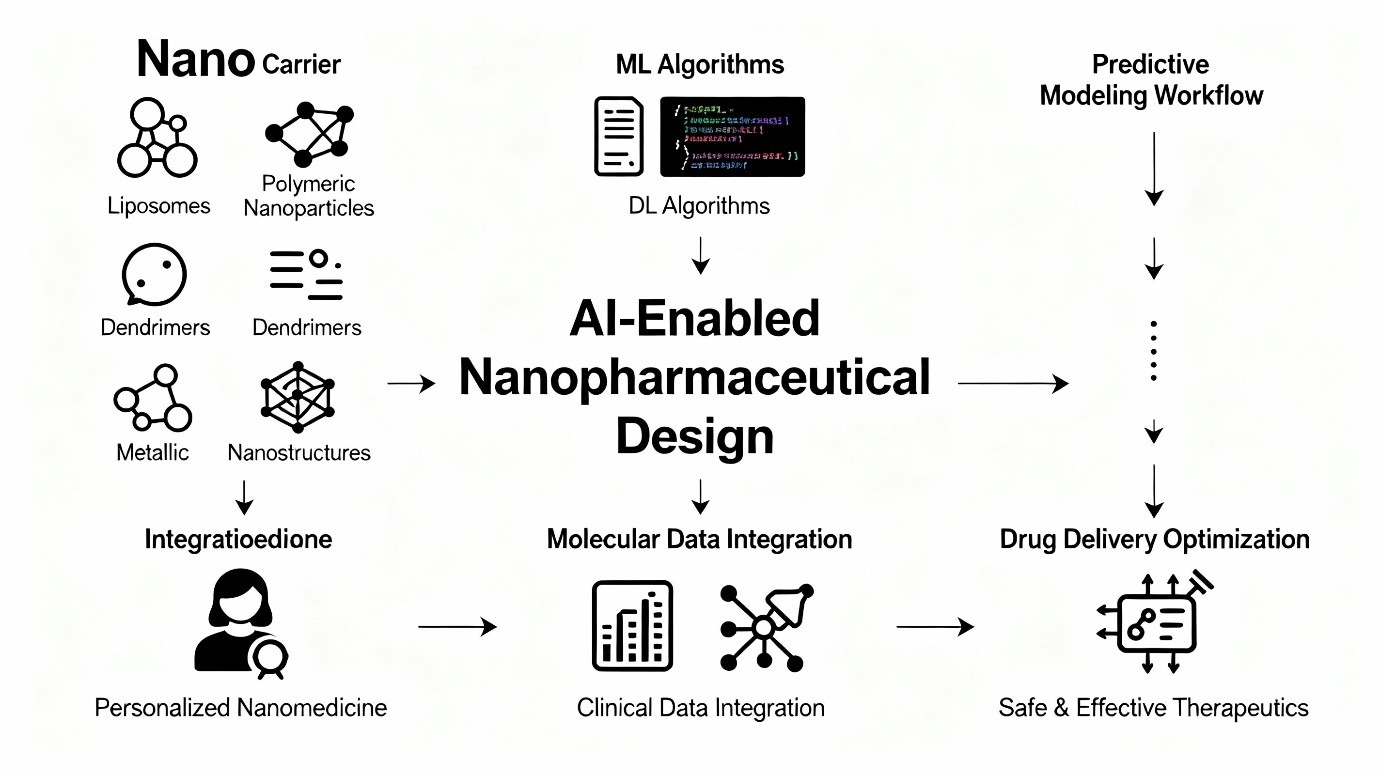
Artificial intelligence (AI) is revolutionizing nanopharmaceutical research by enabling predictive modelling and data-driven optimization of nanoparticle drug delivery systems. Nanopharmaceuticals leverage diverse nanoscale carriers—including liposomes, polymeric nanoparticles, dendrimers, metallic nanoparticles, and micelles—to enhance targeted drug delivery, improve bioavailability, minimize toxicity, and enable site-specific therapeutic action. Traditional nanomedicine formulation faces challenges due to complex multidimensional variables and nonlinear biological interactions. AI-driven approaches, encompassing machine learning, deep learning, and reinforcement learning, provide powerful frameworks to analyze large datasets, identify critical formulation parameters, predict nanoparticle physicochemical and biological behavior, and optimize design workflows. These predictive models accelerate discovery by reducing trial-and-error experimentation, improving manufacturability, and enhancing clinical translation. AI also facilitates personalized nanomedicine by integrating molecular, omics, and clinical data to forecast patient-specific therapeutic responses. Addressing challenges related to data quality, interpretability, safety, and regulatory compliance, AI-enabled nanopharmaceutical design promises to transform drug development into a precision engineering discipline—delivering safer, more effective, and tailored therapies to patients.