Structure-Activity Relationship and Molecular Docking-Guided Development of Andrographolide-Based Antidiabetic Agents
Keywords:
- Andrographolide, Andrographis paniculata, anti-diabetic activity, α-glucosidase, α-amylase, molecular docking, ADME/toxicity, structure–activity relationship, semisynthetic derivatives, natural product optimisation
Abstract
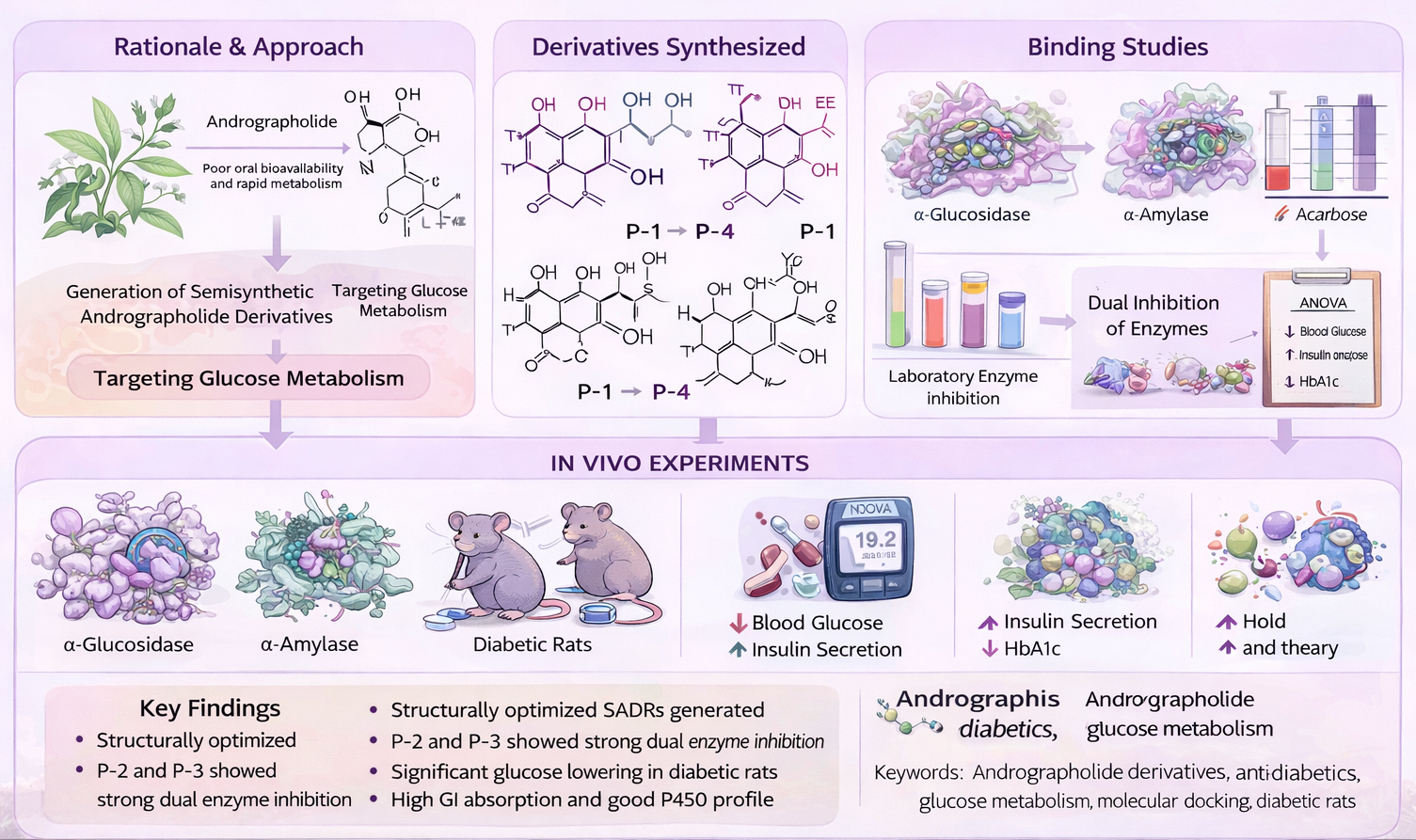
Andrographolide was a type diterpenoid lactone situated in Andrographis paniculata. It has gained attention because it might assist diabetics. Its application, on the other hand, is restricted due to its low oral bioavailability, rapid metabolism and very poor stability in vivo. In this report, we used a rational design strategy to generate semisynthetic andrographolide derivatives (SADRs) and tested for their potency toward targeted enzymes in the glucose metabolism. we synthesised two analogues (P-1 to P-4) and solved the three structures. Molecular docking studies with α-glucosidase and α-amylase reveal the binding mode of our compounds, showing how they inhibit both enzymes. The stable hydrogen bonds and hydrophobic interactions of derivative P-2 and P-3 with component parts of the enzyme are responsible for their strong binding affenity. This means they inhibited the enzyme better than the other compound. The laboratory enzyme inhibition test supported this result, illustrating that P-2 andP-3 had the strong dual inhibitory effect as measuring the standard drug acarbose. In vivo: All experiments were performed on streptozotocin-induced diabetic rats (n=10 per group) versus untreated controls. Design pointed experiments randomised did contain blinded ANOVA confirmed significant, dose-dependent reductions in blood glucose, increased insulin secretion and large decreases in HbA1c were also statistically significant for P–2 at higher doses. The small sample size and lack of long-term follow-up are some significant limitations. Further structure–activity relationship analysis revealed that the maintenance of lactone ring, ideal positioning of hydroxyl groups and balanced hydrophobic–hydrophilic properties are essential for anti-diabitic effectiveness. In silico ADME and toxicity prediction suggested an attractive pharmacokinetic profile, high GI absorption, minimal inhibition of cytochrome P450 enzymes, and reasonably good safety margins for the most actives. In conclusion, these findings demonstrate the potential of structurally optimised andrographolide derivatives as anti-diabetic agents with multi-target activity and underscore the benefit of combining computational docking, structure–activity relationship studies, and biological validation in drug discovery based on natural products.