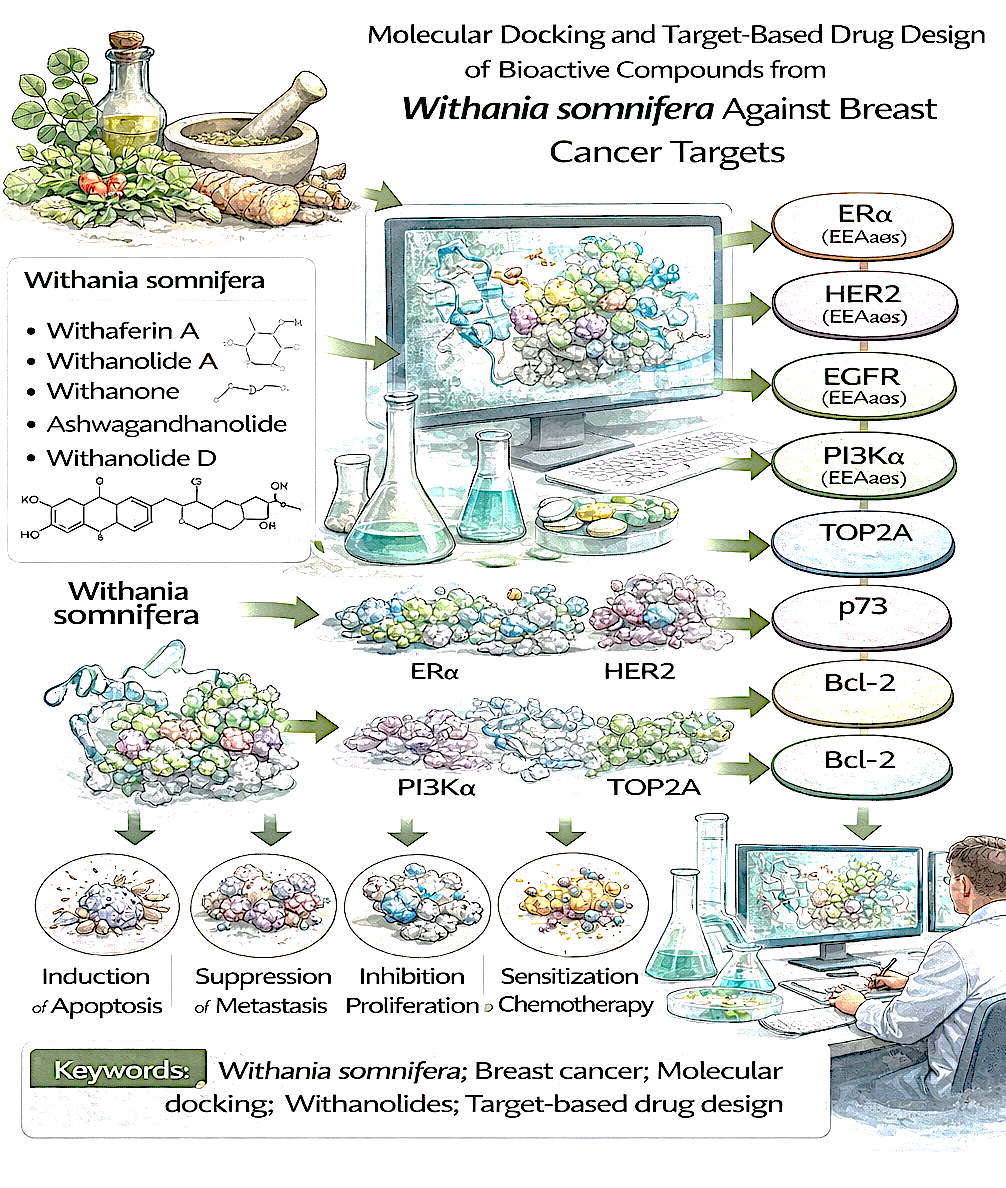
Molecular Docking and Target-Based Drug Design of Bioactive Compounds from Withania somnifera Against Breast Cancer Targets
Keywords:
- Withania somnifera; Breast cancer; Molecular docking; Withanolides; Target-based drug design
Abstract
Breast cancer is the most frequently diagnosed malignancy and the second leading cause of cancer mortality among women worldwide, despite advances in screening, surgery, radiotherapy, endocrine therapy and targeted biological agents. PARC) continued to seek new, safer and multitargeted therapeutics, driven by resistance to existing drugs, toxicity, tumor heterogeneity and the high cost of treatment. Medicinal plants are a valuable source of natural products with bioactive scaffolds that can be rationally optimized through modern computational and structure-based design methodologies. Withania somnifera (L.) Dunal, widely known as Ashwagandha, is a primary ingredient of the Ayurvedic system of medication and has been shown to be a key source of steroidal lactones åknown as withanolidesåand other active ingredients such as withanosides, sitoindosides and alkaloids that possess various pharmacological effects and influence anticancer activity. In cellular and animal models, before clinical studies or in vitro work of withaferin A, withanolide A, withanone (withania withanolides), ashwagandhanolide and other constituents have demonstrated inhibition of proliferation; induction of apoptosis; suppression of metastasis; and sensitization to chemotherapeutics through the modulation of multiple signaling pathways including NF‑κB, STAT3, Notch, PI3K/Akt/mTOR and ER signaling.
Furthermore, recent advances in molecular docking, molecular dynamics (MD) simulations, quantitative structure activity relationship (QSAR) modeling and network pharmacology have facilitated systematic screening of W. somnifera bioactives against a multitude of protein targets implicated in breast cancer pathogenesis such as ERα, HER2, EGFR, phosphatidylinositol‑3‑kinase α (PI3Kα), topoisomerase IIα(TOP2A), 17β‑hydroxysteroid dehydrogenase‑1(17β-HSD1), tumor protein p73 as well as Bcl-2 family members and others. A recent work stands out in this context, where ashwagandhanolide and withanolide sulfoxide were found to be multitarget inhibitors of ERα, 17β‑HSD1, TOP2A and p73 in a PLOS ONE study performed by Lamminga et al., which used docking, MD simulation and ADMET prediction. An article in Drug Design, Development and Therapy (2017), performed docking, QSAR, and ADMET analyses on withanolide analogs for breast cancer targets and outlined structural features associated with activity. This review collates and summarizes the recent bioinformatics data for molecular docking and target-based drug discovery using bioactive compounds of W. somnifera, against various breast cancer targets. It outlines breast cancer molecular subtypes and therapeutic targets, W. somnifera phytochemistry and anticancer pharmacology, big docking, and modeling studies on ER, HER2/EGFR, PI3K/Akt, topoisomerases, apoptotic regulators such as caspase 8/9 (CASP8/CASP9), BCL-2-associated agonist of cell death (BAD), apoptosis-regulating protein PRAP4P and others. It provides a detailed analysis of the alignment between in silico predictions and experimental data, considers ADMET and drug-likeness factors, and emphasizes future strategies to bridge docking with network pharmacology-based approaches, multi-omics frameworks, as well as by utilizing cutting-edge drug-delivery systems to translate W. somnifera phytochemicals into clinically relevant breast cancer therapeutics.